Make it Pay
Growing oyster mushrooms as a side income
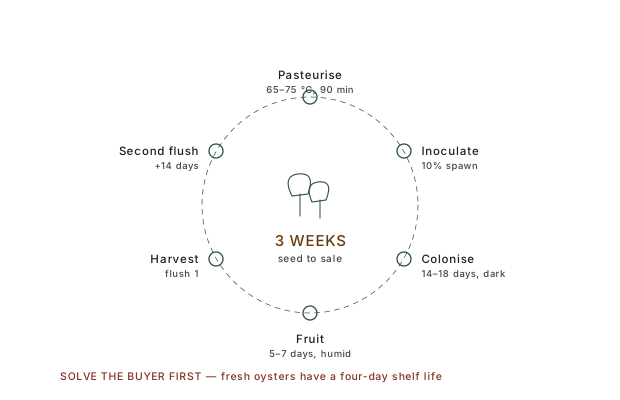
Three weeks from inoculation to harvest, a substrate most people throw away, and the shortest path to a paying buyer of anything on this site.
Pillar 06
The small enterprises that turn a smallholding from a cost into an income, with the arithmetic shown.
A smallholding can generate meaningful side income, but the enterprises that work best are those with short cash cycles, low capital entry, and a product the local market already understands. Worm castings, microgreens, oyster mushrooms, and honey are the four that consistently make financial sense at small scale in South Africa — if the arithmetic is done honestly before the first seed goes in.
Most smallholding income advice is written for places where land is cheap, markets are large, and the grid is reliable. None of those conditions apply uniformly in South Africa, and the enterprises that work on a Yorkshire hobby farm or an Oregon homestead often fail here for reasons that are entirely predictable in advance.
This pillar covers the small enterprises that have a realistic chance of returning more than they cost, at the scale a single household can manage without full-time labour. It does not cover livestock at commercial scale, fresh-produce supply chains, or anything that requires a cold-chain vehicle. The line we draw is this: if you cannot manage it alongside a full-time job in the first year, it is a business, not a side enterprise, and it deserves a business plan rather than a pillar page.
The honest starting point is that most smallholdings run at a net loss for the first two or three years. The enterprises here are chosen because they shorten that period — some can return cash within eight weeks of starting. That does not make them easy. It makes them the right place to begin.
Worm castings and biochar are the two soil-amendment enterprises that share a useful property: both convert waste that a smallholding already produces into a product the market values. Neither requires a dedicated structure in the first phase. Neither is perishable. And both can be scaled incrementally, which matters when you are learning the production process alongside everything else.
A worm farm starts with a feedstock — kitchen scraps, cardboard, paper, green waste — and converts it to a fine, crumbly casting over roughly 60 to 90 days depending on conditions. The worm population doubles roughly every 60 days under good conditions, which means a small initial purchase of Eisenia fetida (red wigglers) can supply a much larger operation within six months without further input cost. The castings themselves are sold to home gardeners, nurseries, and market gardeners who understand the difference between vermicast and bagged compost.
Biochar requires a different input: woody waste that would otherwise be burned or composted slowly. Wattle (Acacia mearnsii), an invasive species across much of the highveld and the KwaZulu-Natal midlands, is the most available feedstock in many parts of South Africa, and processing it into biochar is both ecologically sensible and commercially reasonable. The production article at Biochar from wattle covers the method in detail. The commercial angle is that biochar, once inoculated with compost or castings, commands a meaningfully higher price than plain charcoal and competes directly with imported soil amendments at garden centres.
Castings and biochar are not interchangeable enterprises. Castings demand a consistent wet feedstock and a shaded, managed environment; biochar demands dry woody material and a safe burning setup. Most properties suit one better than the other, and trying to run both simultaneously in year one is a common mistake. Identify which waste stream you already have in abundance and start there.
| Factor | Worm castings | Biochar |
|---|---|---|
| Primary input | Organic wet waste, kitchen scraps | Dry woody waste, invasive species |
| Time to first product | 60–90 days | 4–8 hours per burn |
| Infrastructure needed | Shaded bins or beds, moisture control | Safe burn area, weather-proof storage |
| Shelf life of product | Months if kept moist | Indefinite if kept dry |
| Market | Home gardeners, nurseries, market gardens | Garden centres, organic growers, compost producers |
| Scale ceiling (one person) | Several hundred kilograms per month | Depends on feedstock volume |
The worm farm article at grow/worm-farm covers the practical setup in detail, including the mistakes that kill populations in their first summer.
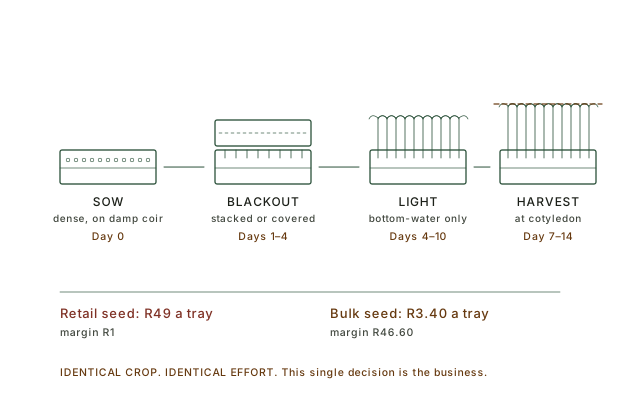
Microgreens are the shortest cash cycle available to a small producer: seed to harvest in 7 to 14 days, depending on the variety. That speed is commercially significant because it means a failed tray costs days, not months, and a successful product can be in the hands of a buyer within a fortnight of starting. The article Microgreens: the shortest cash cycle on a smallholding covers the full production method, variety selection, and the mistakes that produce leggy, flavourless product.
The market reality in South Africa is more constrained than online guides suggest. Most of those guides assume access to restaurants willing to pay premium prices for a consistent weekly supply. That market exists in Cape Town, Johannesburg, and Durban, but it requires reliability that a part-time producer running one heat lamp and a propagation shelf cannot always guarantee. The safer entry point is the direct consumer market — farmers' markets, box schemes, and local WhatsApp buying groups — where the buyer tolerates the occasional gap week and values freshness over uniformity.
The input cost per tray is low: seed, a growing medium (coir or fine compost works well), a tray, and water. The capital cost is also low if natural light is adequate, which it often is on a north-facing windowsill or under a simple polycarbonate shelter for nine months of the year. The cost article for this enterprise is one Lisa should write with current seed-supplier pricing, but the structural arithmetic — yield per tray, trays per shelf metre, harvests per month — is what the production article covers, and it is worth reading before spending anything on equipment.
The varieties that sell consistently in South Africa are sunflower, peas (including snow pea shoots), radish, and the brassica mixes. Wheatgrass sells to a narrower market but commands a higher price per gram. Coriander and basil microgreens are popular but slower to germinate and more temperature-sensitive than the above.
Oyster mushrooms (Pleurotus ostreatus and its close relatives) are the standard entry point for mushroom cultivation at small scale, and for good reason: they grow on widely available agricultural waste, they fruit quickly, and they are already familiar to the mainstream South African consumer in a way that shiitake and lion's mane are not. The full production guide is at Growing oyster mushrooms as a side income, which covers substrate preparation, contamination management, and the humidity requirements that catch most beginners out.
The enterprise has a specific failure mode that is worth naming here: most people who fail at mushroom cultivation fail at contamination control, not at cultivation itself. Grain spawn inoculation in an uncontrolled environment is almost certain to lose some percentage of bags to green mould (Trichoderma), and beginners consistently underestimate how quickly a contaminated bag can spread. The practical answer is to start with pre-inoculated substrate blocks purchased from a supplier, rather than inoculating from grain spawn, until the fruiting environment is understood.
Shiitake requires a longer spawn run (60 to 90 days on hardwood) and a more controlled fruiting environment but commands a higher market price. Lion's mane is gaining consumer recognition and sells well at farmers' markets, but it is more sensitive to CO₂ levels than oysters and harder to manage without dedicated fruiting chambers. Neither is the right starting point. Prove the production system and the market channel with oysters before considering a second species.
The by-product of spent mushroom substrate is worth noting: exhausted oyster blocks, once the fruiting cycle is complete, make an excellent worm-farm feedstock. The combination of mushrooms and a worm farm is one of the more coherent small-enterprise pairings available, because each operation's waste becomes the other's input.
Honey is the enterprise with the longest setup time and the most regulatory complexity, but it is also the one with the most durable local market. South Africans buy honey readily, the product is shelf-stable, the packaging cost is low relative to the value, and a well-managed apiary can produce for decades with comparatively little ongoing capital investment. The detail on keeping hives through a full season is at animals/four-hives-one-season.
The regulatory position matters and is often misunderstood. Honey sold to the public is a food product and falls under the Foodstuffs, Cosmetics and Disinfectants Act 54 of 1972 and its regulations. At small scale — direct sales to known customers at a market — the compliance burden is manageable. At larger scale, or if selling into retail, the requirements around labelling, net weight declaration, and facilities become significant. The still-room article at still-room/mead-from-your-own-hives covers the fermentation side, which has its own separate regulatory considerations under the Liquor Products Act.
South African bees are predominantly Apis mellifera scutellata — the Africanised bee — and they behave differently from the European subspecies that most beekeeping guides are written for. They are more defensive, more prone to absconding when disturbed or when forage declines, and they require a beekeeper who has either trained with someone experienced in local conditions or who is willing to accept a steep early learning curve. Buying a nucleus colony from a reputable local producer and attending an SAPBA (South African Pollinators and Beekeepers Association) introductory course before purchasing equipment is not optional — it is the difference between a productive apiary and an abandoned one.
The enterprise that fails most often on a smallholding is not the farming — it is the pricing. People who are competent at growing, keeping bees, or cultivating mushrooms consistently undercharge, and the reason is nearly always the same: they price against the supermarket shelf price rather than against their actual cost of production, and they do not include their own labour.
The article What a smallholding actually returns for the effort works through the full arithmetic for several enterprise types. What follows here is the structural principle, because the principle applies regardless of which enterprise is being priced.
The channel determines the price ceiling, and choosing the wrong channel is as costly as underpricing. The hierarchy, from highest to lowest margin, runs roughly as follows: direct to consumer at a market or via a buying group; direct to restaurants or food businesses; via a local deli or farm shop on consignment; via a wholesale distributor. Each step down the chain requires more volume and accepts lower margin. A small producer should exhaust the direct channels before considering wholesale, because wholesale margins typically do not survive when the cost of production is calculated honestly.
| Channel | Margin potential | Volume required | Reliability | Admin burden |
|---|---|---|---|---|
| Farmers' market / direct | Highest | Low to medium | Variable (weather, footfall) | Low |
| WhatsApp buying group | High | Low | Good if managed well | Low to medium |
| Restaurant / food business | Medium-high | Medium, consistent | Fragile (chef turnover) | Medium |
| Farm shop / deli (consignment) | Medium | Medium | Good | Medium |
| Wholesale distributor | Lowest | High | Good | High |
Packaging deserves its own note. South African consumers are accustomed to neat, labelled product. A hand-scrawled sticker on a recycled jar will sell at a market once. A clean printed label with a weight declaration and a producer name sells repeatedly and builds the repeat-purchase behaviour that makes a smallholding enterprise financially sustainable rather than a weekly gamble.
The off-grid and smallholding income literature is dominated by North American and British content, and the gap between that content and South African reality is wide enough to be dangerous if a producer follows the advice uncritically.
The most significant structural difference is the cost of reliable infrastructure. Load-shedding is not a minor inconvenience for a producer running a fruiting chamber, a germination shelf, or a refrigerated storage unit — it is an operational risk that must be designed around from the start. A mushroom producer whose fruiting room loses temperature control during Stage 4 at 02:00 loses that flush. A microgreens producer whose heat mat shuts off during a cold highveld night loses germination rates. The power article at power/backup-power-that-works covers the infrastructure side; the point here is that the capital cost of load-shedding protection belongs in the enterprise plan before the first tray goes in.
The second structural difference is the market. South Africa's consumer market for premium local food is real but geographically concentrated and economically stratified. The buyers who will pay a fair price for small-batch, locally produced castings, microgreens, mushrooms, or raw honey are predominantly urban, income-stable, and already connected to a farmers' market or similar community. A producer without access to that market — whether because of distance, transport cost, or the absence of an established market in the area — faces a different and harder problem than the guides suggest.
The third difference is regulatory. South Africa has a functional food safety and agricultural regulatory environment, and it applies to small producers. The Agricultural Products Standards Act, the Foodstuffs Act, and the municipal by-laws around hawking and market trading all exist and are occasionally enforced. None of them are insurmountable at small scale, but they require attention before the enterprise is live, not after the first compliance notice.
The failure patterns across these enterprises are consistent enough to be worth naming plainly.
Guides
Each one names its sources, and says plainly where a figure could not be sourced.
Make it Pay
Three weeks from inoculation to harvest, a substrate most people throw away, and the shortest path to a paying buyer of anything on this site.
Make it Pay
Seven to fourteen days from sowing to selling, in a space the size of a bookshelf. The shortest cash cycle available — and the tightest margins, if you get the seed price wrong.
Make it Pay
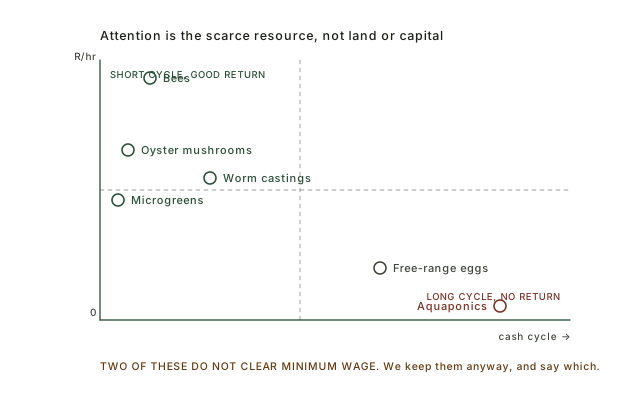
Six enterprises, compared on the only three things that matter: rand per hour, how long until you are paid, and how much you can lose. Two of them do not clear minimum wage.
The other six
Nothing on a smallholding is a closed system. These are the pillars this one touches most.
The Sunday Dispatch
What we are building, what we have sourced, and what it costs — with the supplier named and the quote dated. No affiliate padding, no doom, no filler.
One email every Sunday. Unsubscribe in one click, any time.