Make it Pay
Growing oyster mushrooms as a side income
Three weeks from inoculation to harvest, a substrate most people throw away, and the shortest path to a paying buyer of anything on this site.
The short answer
Oyster mushrooms fruit roughly three weeks after inoculation and produce two useful flushes from a substrate bucket before it is spent. The cash cycle is the attraction — weeks rather than seasons — and the constraint is not growing them but having a buyer before the first flush, because they do not keep. Restaurants are the usual outlet and they buy on consistency, not on volume.
Most smallholding side-hustles fail on cash cycle. You spend in month one and see money in month nine, and somewhere around month five you lose interest.
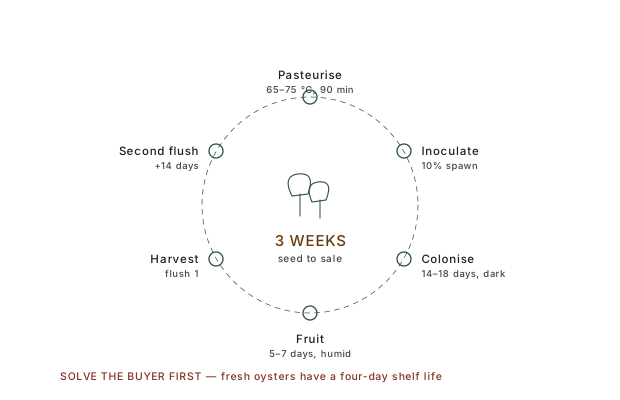
Oyster mushrooms do not have that problem. Three weeks from inoculation to first harvest, a second flush a fortnight later, and a buyer who pays on delivery.
Why oysters and not something else
Because they are aggressive. Pleurotus ostreatus and its relatives colonise substrate faster than most contaminants can establish, which makes them forgiving of the sort of imperfect sterile technique you will actually manage in a shed.
And because the substrate is free or nearly so. Oysters will fruit on wheat straw, on cardboard, on coffee grounds, on sawdust from untreated hardwood. Every one of those is something somebody near you is currently paying to dispose of.
The bottleneck is not growing them
It is selling them, and specifically it is the fact that fresh oyster mushrooms have a shelf life of about four days.
This is the thing to solve first, before you inoculate a single bucket. Find the buyer, agree a weekly quantity and a price, and then size your production to that agreement. Restaurants are the natural customer because they buy weekly, pay reasonably and value freshness — but they will not take an irregular supply, and a chef who is let down twice will not come back.
Do not grow first and sell second. That is the mistake that leaves people with fifteen kilograms of mushrooms and four days.
Pasteurise, do not sterilise
You do not need an autoclave. Straw held at 65 to 75 °C for 90 minutes in a drum over a fire is sufficient — you are knocking competing organisms back, not eliminating everything.
Full sterilisation is for grain spawn, which is a different job and one you can simply buy for the first year. Making your own spawn is the step to add once the rest of the process is reliable, not before.
Why South African conditions help
Our climate suits them, provided you handle humidity. Oysters fruit well between 15 and 24 °C, which is an inland South African autumn and spring almost exactly, and a shaded shed holds that range for much of the year without heating or cooling.
The constraint is our dry air. Fruiting oysters need 80 to 90 percent relative humidity and an inland winter afternoon can sit under 20 percent. That is what a humidity tent or a misting routine is for, and it is the difference between fat clusters and dry, cracked, unsaleable ones.