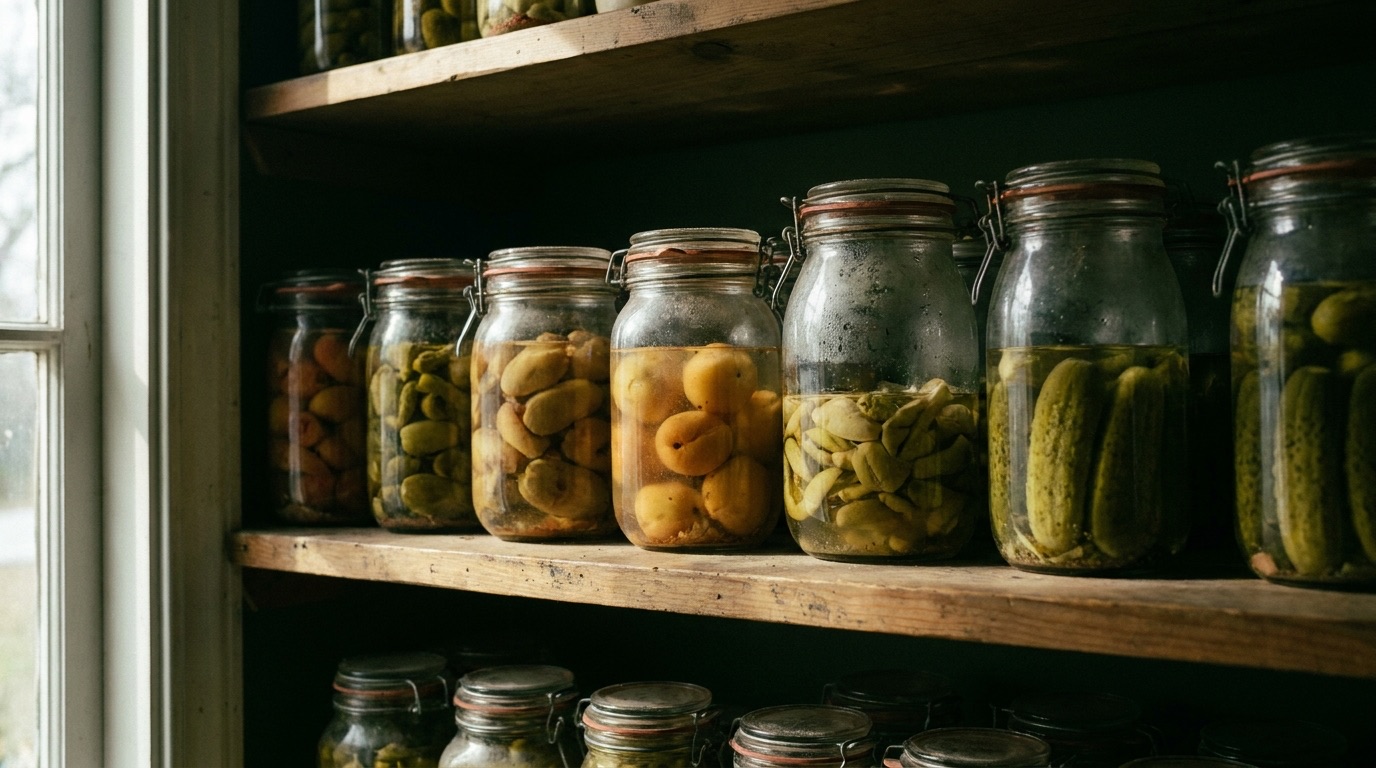
The still room is where a harvest becomes a larder. Ferment what you cannot eat fresh, preserve what fermentation will not suit, store in rotation so nothing rots, and grow the handful of herbs that become salves and infusions. Do all four and a modest garden feeds a household well past its season.
Every tradition of small-scale food production has a room — or a corner, or a shelf — where the work of the garden continues after the harvest. The English called it the still room. The Afrikaner plaas had the spens. Whatever the name, the function is the same: taking what the land grew and turning it into something that keeps.
The still room is not a single technique. It is four overlapping disciplines — fermentation, preservation, storage and remedies — that share one logic. You apply each one to what your land produces, in the sequence that the season dictates, so that nothing goes to waste and the pantry is always working. A single kombucha SCOBY, a shelf of bottled tomatoes, a correctly rotated dry store and a jar of calendula salve are small things individually. Managed together, they change the relationship between a household and the supermarket.
This pillar page explains how those four disciplines fit together and what each one requires. The articles beneath it go into the detail. Start here to understand the shape of the whole; follow the links when you know which specific problem you are trying to solve.
Ferment
Fermentation is the oldest form of food preservation, and it is also the most forgiving entry point into the still room. You do not need special equipment to begin. You need a clean vessel, the right temperature, and an understanding of what you are encouraging and what you are excluding.
The core principle is that certain micro-organisms — bacteria, wild yeasts, cultivated yeasts — convert sugars into acids, alcohol or carbon dioxide in conditions that simultaneously make the food shelf-stable and change its flavour. Lacto-fermentation produces lactic acid, which preserves vegetables. Alcoholic fermentation produces ethanol, which is the basis of beer, mead, wine and cider. Acetic fermentation converts alcohol into acetic acid — vinegar. Kombucha sits at the intersection of several of these: a symbiotic culture of bacteria and yeast converts sweetened tea into a lightly acidic, lightly effervescent drink.
What to ferment first
Vegetables with high water content — cabbage into sauerkraut, cucumber into gherkins — are the easiest starting point because the salt draws out enough liquid to create its own brine.
Kombucha is the right first beverage ferment: the SCOBY is robust, the process is visible, and the feedback loop is fast enough to teach you what healthy fermentation looks, smells and tastes like.
Mead is the next step if you keep bees or have access to raw honey. It requires no crushing, no pressing, and no specialist grain. Honey, water, yeast, patience.
Beer and ginger beer follow naturally once you understand how yeast behaves across a temperature range.
The article How to make kombucha, and keep it alive through an inland South African summer covers the temperature management that separates a live culture from a dead one in a highveld climate — see still-room/how-to-make-kombucha. For honey-based ferments, Mead from your own hives, comb to bottle walks through the full process from raw comb to a finished, stable mead — see still-room/mead-from-your-own-hives.
One boundary to be clear about: this pillar covers fermentation in vessels — crocks, jars, food-grade buckets, demijohns. It does not cover the construction of distillation apparatus. Fermenting is legal and ancient. Distilling without a licence is not, and the Customs and Excise Act 91 of 1964 is unambiguous on the point.
Equipment you actually need
Basic fermentation equipment by category
Item
What it does
Notes
Wide-mouth glass jar (2–5 L)
Primary vessel for vegetable ferments and kombucha
Avoid metal; it reacts with the acid
Glass demijohn (5–25 L)
Primary vessel for mead, beer and wine
Dark glass slows oxidation; a bung and airlock seal it
Airlock and bung
Lets CO₂ out without letting air in
Single-piece silicone airlocks are easy to sanitise
Digital thermometer
Confirms ferment is in the right temperature band
Essential in a climate with 20 °C swings between day and night
pH strips or meter
Confirms acidity is where it should be
Useful for vegetable ferments and kombucha; not essential for mead
Star San or similar no-rinse sanitiser
Kills competing organisms without leaving a flavour
Dilute correctly; residue at the wrong concentration is harmful
Preserve
Preservation overlaps with fermentation but is a distinct discipline. Where fermentation uses biology to change the food into something stable, preservation uses heat, acid, sugar, fat, salt or the removal of moisture to stop biological activity altogether. The aim is the same — keeping food edible beyond its natural season — but the methods and the safety rules are different.
The main methods and when to use each
Water-bath canning works for high-acid foods: tomatoes, citrus, most fruit, pickles. The acid environment prevents the growth of Clostridium botulinum, which is the organism you are managing above all others. A water bath reaches 100 °C, which is sufficient for high-acid foods.
Pressure canning is required for low-acid foods: beans, peas, corn, meat, fish, plain vegetable stock. These require 116 °C to destroy botulinum spores, which only a pressure canner achieves. A normal pot of boiling water cannot do this job, and attempting it is how people die.
Drying removes water below the threshold that micro-organisms need. A solar dryer, a dehydrator, or simply a rack in a well-ventilated room on a hot dry day all work. Herbs, chillies, tomatoes, mushrooms and many fruits dry well.
Lacto-fermented pickling (covered under Ferment) creates its own preservation environment through acidity.
Bottling in oil or vinegar preserves texture as well as flavour for items such as roasted peppers, sun-dried tomatoes and pesto. The safety rule: ensure the pH of the finished product is below 4.6, or refrigerate.
Jams and conserves use sugar as the preservative. Sufficient sugar concentration, combined with the acid from fruit or added lemon juice, creates an environment hostile to spoilage organisms.
The article Preserving what you grew: drying, bottling and the safety line covers the pH and temperature thresholds that separate safe home preservation from a dangerous one — see still-room/preserving-what-you-grew. The safety line in the title is not rhetorical: botulism is rare precisely because the rules work when followed, and it is serious when they are not.
The rule that matters above all others
If you are not certain whether a food is high-acid or low-acid, treat it as low-acid and use a pressure canner. When in doubt, refrigerate and eat within a week. A spoiled jar is a small loss. An improperly processed jar of low-acid food is a medical emergency. The National Center for Home Food Preservation at the University of Georgia publishes tested recipes and processing times; these are the ones to use, not recipes passed down through families without provenance.
Store
Storage is the third discipline, and it is the one most people get wrong by accident. Fermentation and preservation create shelf-stable food. Storage is what you do with it afterwards, and poor storage undoes careful preservation in a surprisingly short time.
A working pantry has two properties that most pantries lack: it maintains consistent conditions, and it rotates. Consistent conditions means cool, dark and dry — the three enemies of shelf life are heat, light and humidity, and in a South African climate all three are present in abundance for most of the year. Rotation means first-in-first-out: the jar you preserved longest ago is at the front of the shelf, and the new one goes behind it.
What storage requires by product type
Storage conditions by product category
Category
Ideal temperature
Humidity
Expected shelf life
Key risk
Water-bath canned goods
Below 25 °C
Dry
12–18 months
Seal failure if stored near heat sources
Pressure-canned goods
Below 25 °C
Dry
12–18 months
Same; check lids for flex before opening
Dried vegetables and herbs
Below 20 °C
Below 60% RH
6–12 months
Rehydration in humid conditions, leading to mould
Dried pulses and grains
Below 20 °C
Dry; airtight container
1–3 years
Weevils; oxygen absorbers address this in sealed containers
Root vegetables (unwashed)
Cool and dark
Moderate; not wet
4–12 weeks
Rotting spreads rapidly — check weekly
Fermented beverages (still)
Below 18 °C
Irrelevant once sealed
6–24 months
Refermentation in bottle if residual sugar remains
The article A pantry that rotates: three months of food that does not go to waste builds the system from the ground up — how to map what you have, how to sequence production so the shelf is always replenishing, and how to avoid the common failure where a household preserves forty jars of one thing in October and finds half of them still there in March — see still-room/a-pantry-that-rotates.
The load-shedding problem
Refrigerated storage is unreliable when the grid is unreliable. A chest freezer full of meat that goes through four cycles of partial defrost in a week is not the safe store it appears to be. The still room is a hedge against exactly this: shelf-stable food does not care about Eskom. The practical implication is that preserving more and freezing less is not a lifestyle choice in the South African context — it is a resilience decision.
Remedy
The fourth corner of the still room is remedies: preparations made from plants, used for minor first aid, household medicine and skin care. This is the corner with the most legal complexity, and clarity about what is and is not permitted matters before you start.
The Medicines and Related Substances Act 101 of 1965 regulates the claim, not the product. You may make a calendula-infused oil and apply it to dry skin. You may not write on the label, or publish in an article, that it treats eczema. The first is a preparation; the second is a medicinal claim. The distinction is not a technicality — it is the line between a household preparation and an unregistered medicine. Nothing in this pillar makes a medicinal claim, and nothing in the articles beneath it does either.
What belongs in a household remedy shelf
Infused oils: dried herb material steeped in a carrier oil (olive, sunflower, sweet almond) for three to six weeks, or gently heated in a double boiler for a faster result. Calendula, lavender and comfrey are the most commonly useful.
Salves and balms: an infused oil set with beeswax at roughly a 5:1 oil-to-wax ratio by weight. The wax concentration determines the firmness; a lip balm wants more wax than a hand salve.
Tinctures: herb material extracted in food-grade alcohol, typically 40–60% ABV, for four to six weeks. Useful because alcohol extracts different compounds than oil or water, and the shelf life is several years.
Decoctions and infusions: the domestic end of herbal medicine — a tea or a longer-simmered decoction of roots and bark. Made fresh, used within a day or two, and not shelf-stable without preservation.
Herbal vinegars: herb material extracted in apple cider vinegar. A gentler extraction medium than alcohol, useful where an alcohol preparation is not appropriate.
The article Salves and infusions from what you already grow covers the preparation method in detail — which herbs transfer well to oil, which require a water or alcohol medium, and how to tell whether an infused oil has gone rancid — see still-room/salves-and-infusions.
Which plants are worth growing for this purpose
The most useful plants for a household remedy shelf are those that grow easily in a South African garden and have a long track record of safe topical or culinary use. Calendula officinalis, lavender, rosemary, lemon balm, comfrey (external use only), chamomile, and yarrow cover the majority of what a household needs. A herb bed of two or three square metres, well-positioned, produces more than most households can use.
Why the still room is different in South Africa
Where most people go wrong
The still room is one of the areas of off-grid and self-reliant living where the errors are not expensive — they are just discouraging, and discouraging errors early in the process cause people to stop. Most of them are avoidable.
Preserving without a rotation system
The most common failure is producing a large volume of preserved food in a single season with no system for consuming it in order. The result is a pantry where half the jars are past their ideal shelf life, the older ones are pushed to the back, and the household ends up buying the same food at the supermarket while the preserved version sits forgotten. Preservation without rotation is not a food system — it is a museum of good intentions. Build the rotation before you preserve the first jar.
Applying Northern Hemisphere temperature assumptions
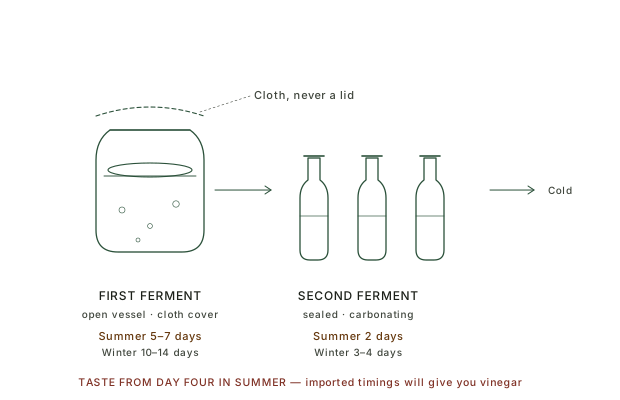
Most published fermentation guidance — books, websites, YouTube channels — is written for kitchens that run at 18–22 °C year-round. A South African kitchen in February is not that. Fermentation runs faster, hotter and more aggressively in summer conditions, which accelerates the process but also narrows the window between ready and over-fermented. A kombucha that takes fourteen days in a London kitchen may be ready in five days in Johannesburg in January, and unpleasant by day seven. Adjust for your actual environment, not the recipe writer's.
Confusing high-acid and low-acid foods
Water-bath canning is safe for high-acid foods. It is dangerous for low-acid foods. The error is usually not deliberate — it comes from recipes shared within families or communities where the distinction was never explained. Tomatoes are close enough to the 4.6 pH boundary that the standard advice is to add lemon juice or citric acid to every jar to ensure the acidity is sufficient. Butternut, pumpkin, sweetcorn and dried beans are definitively low-acid and require pressure canning. There is no workaround, no grandmother's method that makes them safe in a water bath. If you do not have a pressure canner for low-acid foods, dry or ferment them instead.
Storing in the wrong conditions
A sealed jar of tomatoes that spent a summer on a shelf above the stove has lost most of its nutritional value and a good deal of its flavour by the time it is opened, even if the seal held. Heat degrades preserved food even inside a sealed container. If a cool, dark, dry dedicated space is not available, a thermally stable outbuilding — a cellar, a north-facing storeroom, a buried container — is worth building or adapting before putting effort into filling it.
Where to start
Audit what the garden produces in a twelve-month cycle before you decide what to preserve. A still room that processes tomatoes and chillies requires different equipment and methods than one that processes apples and stone fruit.
Build the storage space before you build the production capacity. A shelf of correctly labelled, rotated jars in a consistently cool room is the goal; the canning pot and the fermentation crocks are how you fill it.
Start with lacto-fermentation — salt, vegetable, jar, lid. It costs almost nothing, fails visibly and non-dangerously, and teaches you more about how micro-organisms behave than any other starting technique.
Add kombucha once you have a source for a SCOBY and understand your kitchen's temperature range across the seasons. Read still-room/how-to-make-kombucha before you start rather than after your first batch fails.
Invest in a pH meter and a pressure canner before you begin canning low-acid foods. These are not optional equipment upgrades — they are the difference between a safe pantry and a dangerous one.
Grow five to ten herb plants specifically for the remedy shelf: at minimum, calendula, lavender, lemon balm and rosemary. They require almost no space and produce usable material in the first season.
If you keep bees or have access to bulk honey, read still-room/mead-from-your-own-hives before autumn — mead benefits from long conditioning, and a batch started in March will be ready by the following winter.
Read still-room/a-pantry-that-rotates before you preserve more than you can eat in a single month. The rotation system is easier to build from the start than to retrofit later.
Guides
In this pillar
Each one names its sources, and says plainly where a figure could not be sourced.
The ratio is simple and the method is forgiving. What is not forgiving is our summer — an inland South African January ferments a batch in half the time every recipe on the internet tells you.
Four hives, one harvest, and the most complete closed loop in these conditions. Also the point at which it is worth being very clear about what you may and may not sell.
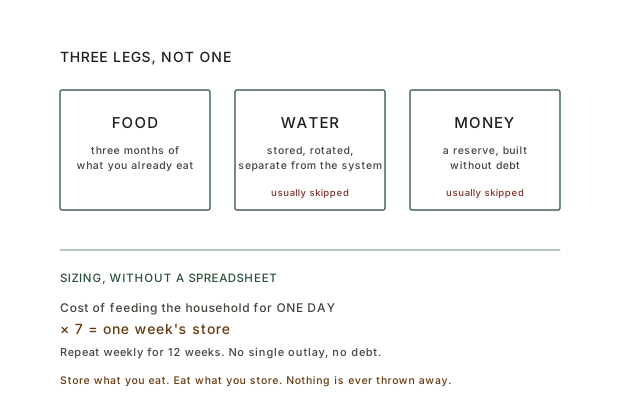
Not a bunker. A deeper version of the cupboard you already have, sized by arithmetic rather than by anxiety, and rotated so nothing is ever thrown away.
A glut is a problem, not a triumph. Drying, bottling and fermenting are the three answers — and one of them has a hard safety line running through it that is worth understanding properly.
If you are growing calendula, lavender, or buchu and doing nothing with the harvest, you are leaving the most useful part of the still-room unused. Making infused oils and salves is a one-afternoon process that requires no special equipment.