Make it Pay
What a smallholding actually returns for the effort
Six enterprises, compared on the only three things that matter: rand per hour, how long until you are paid, and how much you can lose. Two of them do not clear minimum wage.
The short answer
Judge a smallholding enterprise on three measures: rand per hour of attention, cash cycle length, and capital at risk. On those measures oyster mushrooms, worm castings and bees perform best; aquaponics and free-range eggs perform worst at small scale. Anything with a cycle longer than six months will lose your attention before it pays.
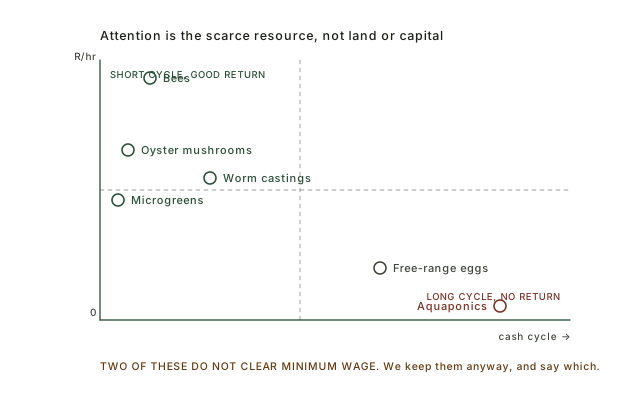
Most writing about smallholding income is produced by people whose actual income is selling courses about smallholding income. The figures are optimistic, the labour is uncosted, and the failures are absent.
What follows is narrower, duller and more useful: six things we have run in these conditions, compared on three measures that decide whether an enterprise survives contact with real life.
The three measures
- Rand per hour of attention. Not per hectare, not per rand invested. Your attention is the scarce resource on a smallholding and it is what actually runs out.
- Cash cycle. How long between spending and being paid. Anything over six months will lose your interest before it pays, regardless of the eventual return.
- Capital at risk. What you lose if it fails entirely. This is what decides whether you can afford to be wrong.
What the winners have in common
Three things, and it is worth being explicit because it is a usable filter for any new idea.
A short cycle. Mushrooms in three weeks, microgreens in two. You find out quickly whether it works, you fail cheaply, and the money comes back before your enthusiasm runs out.
An input you already have or must deal with anyway. Wattle you are legally obliged to clear becomes biochar. Kitchen waste becomes castings. Bees forage on what is already growing. If an enterprise needs you to buy its main input, the margin is somebody else's.
A buyer within driving distance who buys weekly. This is the one people skip, and it is the one that kills more small enterprises than any growing problem. Restaurants, delis, farm stalls, neighbours. Named, agreed, before you produce anything.
The honest summary
A smallholding will not replace a salary, and anyone telling you otherwise is selling something. What it will do — reliably, on the numbers above — is cover its own running costs and produce a meaningful share of your food.
That is a genuinely good outcome and it does not need exaggerating.