Water
Converting a chlorine pool to a natural swimming pool
A swimming pool filtered by plants instead of chemicals. What the regeneration zone has to do, how big it must be, and the arithmetic against ten years of chlorine and pump electricity.
The short answer
A natural swimming pool replaces chemistry with a planted regeneration zone, which must be roughly 30–50% of the total water surface to work. Converting an existing pool turns on how much of the shell and plumbing you reuse. Against a conventional pool you trade a recurring monthly cost — chemicals, pump electricity, servicing — for a larger one-off build and a seasonal maintenance rhythm instead of a weekly one.
South Africa has an enormous installed base of private swimming pools, and almost every one of them is a small monthly bill that never ends. Chlorine, acid, stabiliser, a pump running six hours a day, a service call when the chlorinator cell fails.
There is a well-established alternative that almost nobody here writes about. And the search data says people are looking: natural pool returns 480 searches a month in South Africa at a keyword difficulty of 17, with almost no commercial competition. That is a genuine gap.
How does a natural swimming pool work?
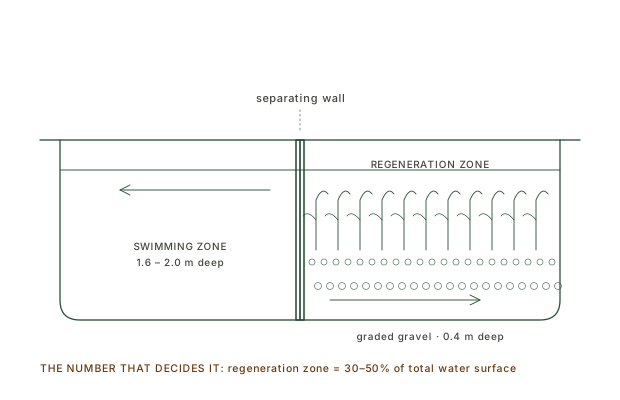
You divide the water into two connected bodies. One you swim in. The other — the regeneration zone — is shallow, densely planted, and filled with a graded gravel substrate.
The work is not really done by the plants. It is done by the biofilm growing on every surface of that gravel, which strips dissolved nutrients out of the water. Remove the nutrients and algae has nothing to live on. The plants compete for the same nutrients and shade the water, which helps, but the substrate is the engine.
Water is moved slowly and continuously between the two zones. There is no chlorine, no acid and no salt chlorinator.
How big does the regeneration zone need to be?
Between 30 and 50 percent of total water surface area. Below about 30% the system runs on a knife edge and goes green in a hot February; the established European guidance sits nearer 50% and there is no good reason to think our summers are gentler.
This is the number that decides whether a conversion is viable on ya smallholding. If your pool is already at the boundary of the paving, the regeneration zone has to go somewhere, and that somewhere is usually garden.
Why South African conditions change the answer
Two things work in our favour and one very much does not.
In our favour: light. A regeneration zone in an inland South African summer is a ferociously productive place, and the biological load is processed far faster than in a northern European installation. The systems establish quickly here.
Also in our favour: we already have the shell. A conversion is a fraction of a new build, and the most expensive single element of a natural pool — the excavation — is half done.
Against us: our summer heat drives evaporation hard, and a shallow planted zone evaporates far faster than open water. Top-up demand is real and it is why this belongs beside a borehole or a rainwater system rather than on a municipal connection.
Where people get this wrong
The commonest mistake is sizing the regeneration zone to whatever space is left over rather than to the water volume it has to clear. Undersized zones do not clear, and no amount of planting afterwards compensates for it.
Who should not do this
If you want a pool that looks like a pool — blue, sterile, sharp-edged — this is not it. A natural pool looks like water in a landscape. There will be tadpoles. In our climate there will be dragonflies, and if you have planted well there will be frogs, which is a feature to some people and emphatically not to others.
And if you have no space beside the existing shell, the honest answer is that a conversion will not work on ya smallholding. The zone is not optional and it cannot be shrunk to fit.